
Rationale for Endoscopic Ear Surgery
In clear contrast to the impact of the introduction of endoscope in most surgical disciplines, the practice of ear surgery has changed little and it continues to be the domain for the microscope. Depending on the task at hand, there are many distinctions that would make the endoscope a better instrument than the microscope and vice versa. We all need to master working with both instruments to better understand and treat pathologies of the ear. The objective of this group and this web site is to neutralize these longstanding biases toward the microscope and to get all of us to use the best instrument in the best way possible to help our patients.
The ability to place the surgeons eyes within the ear cavity using angled endoscopes, allows the operator a contextual understanding of the anatomy that is difficult to match using the microscope. The disease/ anatomical interface is better appreciated. This improved anatomical understanding, in turn provides confidence in surgical procedures both endoscopically and microscopically.
When compared to the microscope, two distinct advantages are present with the endoscope.
- The Objective lens is placed within the ear canal or middle ear, which allows for an all-encompassing contextual view of the disease/ anatomy interface. In contrast, the traditional microscopic method relies on removal of significant amounts of normal bone and soft tissue, often with removal of intact structures to fully observe the disease extent.
- The live image used by the surgeon is the same one that everyone else in the operating room is observing. This simultaneous viewing significantly increases engagement, teaching opportunities and interest in the surgical procedure from all present in the OR.
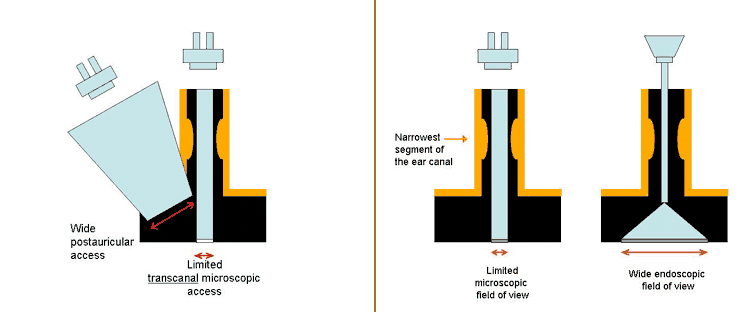
The use of the endoscope enables the surgeon to visualize past the shaft of larger surgical instruments, such as drills and curettes, and allows better visualization of anatomical structures.
To view the up to date research on Endoscopic Ear Surgery, please visit the link below.
 endoscopy ear
- Laryngeal Manifestations of Rheumatic Disease October 8, 2026Rheumatologic diseases are systemic, immune-mediated disorders that frequently involve the larynx, producing manifestations that range from subtle dysphonia to life-threatening airway obstruction. Laryngeal involvement may precede systemic disease, progress despite adequate systemic control, or be the sole presenting feature of active disease. Diagnosis relies on flexible laryngoscopy with disease-specific serology and biopsy when indicated. Corticosteroids, […]Peter S Giannaris
- Silent danger behind the forehead: Pott's puffy tumour presenting without systemic symptoms October 7, 2026Pott's puffy tumour (PPT) is a rare complication of frontal sinusitis involving subperiosteal abscess and frontal bone osteomyelitis, often leading to serious intracranial sequelae. We report a case of a man in his 50s who presented with progressive, painless forehead swelling despite multiple antibiotic courses. Imaging confirmed bilateral subperiosteal collections and a right-sided epidural empyema. […]Ana Rita Rodrigues
- A simple oral endotracheal intubation technique in rats using a modified 5-Fr vascular sheath and a commercially available ear-pick endoscope October 7, 2026Oral endotracheal intubation in rats is useful for cranial, thoracic, and survival experiments but remains technically demanding. We evaluated a simple method using a modified 5-Fr vascular sheath and a smartphone-connected ear-pick endoscope in 30 male Sprague-Dawley rats (8-12 weeks, 300-400 g). Under 3% isoflurane anesthesia and vecuronium bromide-induced neuromuscular blockade, the sheath was shortened […]Toru Yoshiura
- Rare Migrated Fishbone Foreign Body in the Nasopharynx October 1, 2026Although impaction of the pharyngoesophageal fishbone represents a common otolaryngological emergency, migration of an ingested fish bone into the nasopharynx is an extremely rare clinical occurrence. We present a 57-year-old woman who developed acute odynophagia one hour after fish ingestion, accompanied by a single choking episode, in the absence of nausea or vomiting. The oropharyngeal […]Changqing Wang
- EXPRESS: Modified transcanal perendoscopic myringotomy and septotomy technique for cats with otitis media - a retrospective study of 38 cats September 28, 2026ObjectivesThis study solely aims to describe a convenient minimally invasive technique for access to the ventromedial compartment of the middle ear in cats with polypoid or non-polypoid otitis media.MethodsPatients' records were retrospectively retrieved from cats with otic symptoms. Cats were included based on the presence of fluid/soft tissue within the tympanic cavity on CT imaging, […]Bas Nicolaas Wetzels
- Development and Preliminary Evaluation of an Endoscopic Eustachian Tube Orifice Patency Score (ETOPS): A Pilot Study September 21, 2026CONCLUSION: The proposed ETOPS may serve as a simple and reproducible endoscopic grading system for evaluating Eustachian tube dysfunction. Further validation using real patient data is required to establish its clinical utility.Regin William
- Rhinolithiasis as a Nidus for Polymicrobial and Anaerobic Colonization: A Case Report September 18, 2026Rhinolithiasis is a rare and underrecognized etiology of chronic sinonasal obstruction and rhinorrhea. The clinical presentation of rhinolithiasis often mimics chronic rhinosinusitis, though often presenting with unilateral symptoms. While most reported cases of rhinolithiasis focus on the clinical presentation and management, the microbiologic characteristics of rhinoliths remain poorly described. We report the case of a […]Daniel Frascella
- Endoscopic recannulation with temporary steroid-eluting biodegradable stenting as a bridge strategy for complete subglottic stenosis in a child with CHARGE syndrome September 17, 2026Complete (Cotton-Myer grade IV) subglottic stenosis (SGS) is a severe form of airway obstruction traditionally managed with open airway reconstruction. Children with CHARGE syndrome frequently present with complex airway abnormalities and medical comorbidities that may complicate airway management and increase surgical risk.We report the case of a toddler with CHARGE syndrome who developed complete SGS […]Thomas Schrepfer
- Radiologically occult nasopharyngeal carcinoma: the importance of clinical suspicion and repeat biopsy September 16, 2026A man in his 40s undergoing long-term otolaryngology surveillance following an initial diagnosis of a left-sided nasopharyngeal lesion classified as carcinoma in situ re-presented approximately 3 years later with intermittent aural fullness and tinnitus. Flexible nasendoscopy demonstrated subtle unilateral polypoidal change at the left eustachian tube orifice and fossa of Rosenmüller (FOR), while MRI remained […]Aubrey Gaylard
- A Case of Bilateral Congenital Aural Stenosis with Down Syndrome Underwent Canalplasty with Underwater Transcanal Endoscopic Ear Surgery September 13, 2026Congenital aural stenosis (CAS) sometimes can be a risk for external auditory canal (EAC) cholesteatoma and may require surgical treatment. We report a child of Down syndrome with bilateral CAS who underwent bilateral canalplasty with underwater transcanal endoscopic ear surgery (TEES). Case Report: A 12-year-old boy with bilateral EAC stenosis, in whom tympanostomy tube insertion […]Chikako Shinkawa